Hybrid Inverter — The Most Important Component in Decentralized Energy Systems?
- May 28
- 3 min read

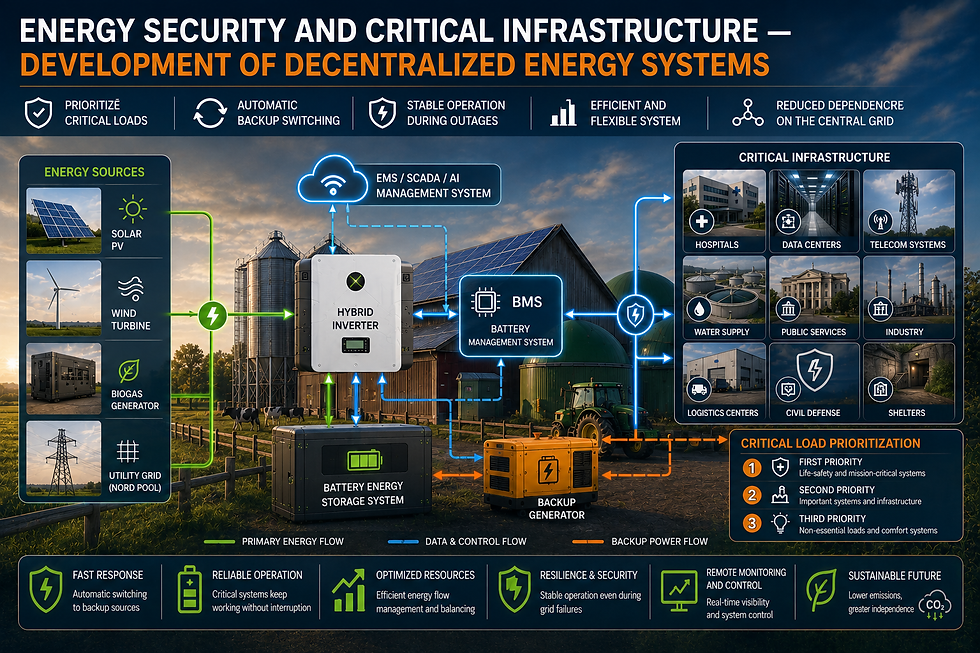
In recent years, decentralized energy in Europe has been developing very rapidly.More and more systems now include:
🟧✓ solar panels
🟧✓ small and medium-sized wind turbines
🟧✓ battery storage
🟧✓ Nord Pool optimization
🟧✓ infrared heating
🟧✓ autonomous drinking water generation from air (AWG)
🟧✓ backup systemsHowever, in practice, most people still focus mainly on:solar panel output,battery capacityand wind turbine size
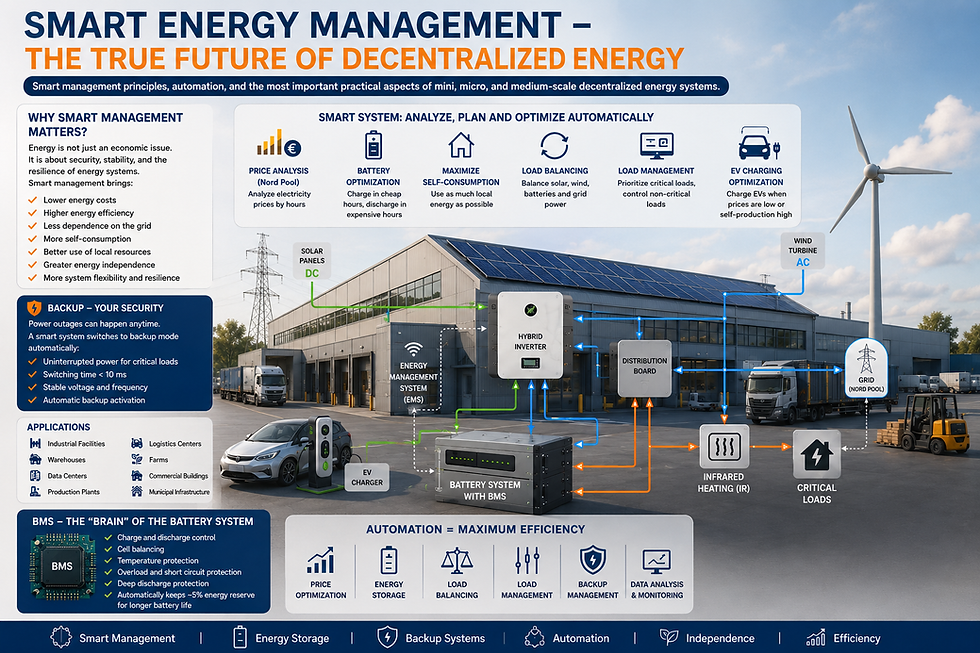
Athe same time, the most important system component is very often overlooked:= the hybrid inverter.And in practice, this is where the most expensive mistakes often begin.Because in decentralized energy systems, the inverter becomes the “brain” of the entire system.,very often determines:
🟧✓ system stability
🟧✓ battery operation
🟧✓ automation capabilities
🟧✓ self-consumption optimization
🟧✓ backup functionality
🟧✓ the ability to integrate multiple energy sources
🟧✓ future system expansion possibilitiesRecent years increasingly show that in energy systems,it is no longer only electricity production that matters,but also energy availability and system resilience during power outages.
That is why backup systems are becoming increasingly important:for private homes,businessesand industrial
facilities.From our side, we recommend:
DEYE and SOLIS hybrid inverters with wind integration capabilities.I is important to understand:
- not all hybrid inverters are designed to work with wind turbines.Many hybrid inverters on the market work very well in standard solar systems,however:
they are not designed for proper integration with wind turbines or more complex decentralized energy systems practice, people very often discover inverter limitations only after the system has already been installed.And this is where most problems begin.For example:
🟧✓ all 3 phases do not operate in backup mode
🟧✓ generator integration is not possible
🟧✓ insufficient backup power for heat pumps
🟧✓ wind turbine integration is not properly supportedThis becomes especially
important in systems where multiple technologies are integrated simultaneously:
🟧✓ solar panels
🟧✓ wind turbines
🟧✓ battery storage
🟧✓ EV charging
🟧✓ backup systems
🟧✓ smart energy managementThat is why it is very important from the beginning
to understand:
- how the energy system may evolve in the future.Because decentralized energy systems very often develop gradually.Initially:
🟧✓ solar panelsLater:
🟧✓ battery storage
🟧✓ EV charging
🟧✓ wind turbines
🟧✓ infrared heating
🟧✓ AWG systems
🟧✓ backup solutions
🟧✓ smart energy managementBoth DEYE and SOLIS allow:
🟧✓ battery storage integration
🟧✓ combining solar and wind
🟧✓ self-consumption optimization
🟧✓ decentralized energy system developmentHowever, there are also significant differences between these
practice, DEYE is more often selected for:
more advanced decentralized energy systems with:
🟧✓ generator integration
🟧✓ backup modes
🟧✓ multiple energy source integration
🟧✓ more flexible automation
🟧✓ hybrid and off-grid scenarios
🟧✓ more flexible energy managementOne of DEYE’s major advantages:
- generator connection capability.This becomes especially important for:
🟧✓ facilities with unstable electrical grids
🟧✓ decentralized energy systems
🟧✓ agricultural and industrial sites
🟧✓ backup solutions for critical loadsMeanwhile, SOLIS often proves itself as:
a stable and relatively simpler solution.Especially for:
🟧✓ standard hybrid systems
🟧✓ less complex installations
🟧✓ projects without generator integration
🟧✓ systems with simpler automation requirementsIn our view, the future of decentralized energy will increasingly rely not on “individual devices”,but on intelligently integrated energy systems.When planning a decentralized energy system,it is very important from the beginning to understandhow the system may evolve in the future.Because in practice, the inverter very often determines:
- how stable,
expandableand resilient the entire system will become.Related articles:
🟧✓ How Wind Helps During the Heating Seasonhttps://www.sundirect.lv/en/post/how-wind-helps-during-the-heatinFixed Pitch vs Pitch Control — Which Wind Turbine System Works More Efficiently?https://www.sundirect.lv/en/post/fixed-pitch-vs-pitch-contro
🟧✓ Installation Nuances — Practical Factors That Determine Wind Turbine Efficiencyhttps://www.sundirect.lv/en/post/installation-nuances-practical-factors-that-determine-wind-turbine-efficiency
🟧✓ Decentralized Energy — Europe’s New Energy Realityhttps://www.sundirect.lv/en/post/decentralized-energy-europe-s-new-energy-reality
🟧✓ Wind Turbines for Nordic Climate Conditions
ttps://www.sundirect.lv/en/contact--------------------------------------------------------------------------------------------------------------------Pēdējos