❄️ Heating Safety and System Selection in Latvia’s Extreme Winter
- Feb 2
- 4 min read

In Latvia’s climate, where winter temperatures regularly drop to –10…–20 °C, the reliability of a heating system is just as important as its energy efficiency.
Centralized heating solutions — pellet boilers, heat pumps, gas boilers, and district heating — rely on a single main heat generation unit. In the event of a malfunction or power outage, heating can be lost throughout the entire building at once, significantly increasing the risk of frozen pipes and structural damage.
Pellet boilers, all types of heat pumps, gas boilers, and district heating operate as a single central heat source. If this main unit stops working:
Indoor temperatures drop rapidly
Water pipes can freeze in a short time
Pipe bursts and costly repairs may occur
Heating is lost in the entire building at once
Additional Risk for Heat Pumps in Latvian Winters
For heat pump systems, the outdoor unit is especially critical, as it operates continuously in low outdoor temperatures:
At –15 °C to –25 °C, efficiency decreases significantly
Defrost cycles and electronic failures may occur
In the event of a power outage, the system stops completely
This means that a single failure in the outdoor unit can shut down heating throughout the entire building.
Decentralized Approach: Infrared Heating
An infrared heating system consists of individual heaters in each room. If one heater stops working, heat remains in the other rooms, and the faulty panel can be replaced quickly.
The system does not depend on a single central unit. This:
🟧✓ Reduces the risk of system failure
🟧✓ Ensures stable heating even in extreme winter conditions
🟧✓ Simplifies long-term maintenance
🟧✓ Provides predictable operating costs
Comparison of Heating Systems in Latvia’s Climate
Heating season in Latvia: October – April
Criterion | Centralized Heating (Pellet Boiler, Heat Pump, Gas Boiler, District Heating) | Infrared Heaters |
Heat source | One central unit (except air-to-air heat pumps with separate indoor units) | 🟧✓ Individual in each room |
In case of failure | Heating is lost in the entire building | 🟧✓ Heating remains in other rooms |
Winter system safety | Dependence on one main unit | 🟧✓ Risk distributed across rooms |
Repair speed | Service and spare parts required | 🟧✓ Fast heater replacement |
Risk of frozen pipes | High in case of prolonged failure | 🟧✓ Significantly lower |
Performance in low temperatures | Heat pump efficiency drops; backup electric heater activates 🟧★ | 🟧✓ Efficiency remains constant (COP = 1) |
Fuel required | Yes | 🟧✓ No |
Dependence on fuel supply | High | 🟧✓ None |
Use of PV energy for heating | Partially direct | 🟧✓ Direct |
Battery compatibility | Partially efficient | 🟧✓ Highly efficient |
Maintenance | Regular | 🟧✓ Not required |
Boiler/technical room | Required | 🟧✓ Not required |
Chimney/flue | Required | 🟧✓ Not required |
Zone control | Possible with inertia | 🟧✓ Precise room-by-room control |
System mobility | Not possible without major renovation | 🟧✓ Easily removable and reinstallable |
Future system flexibility | Medium (15–20 years) 🟧★★ | 🟧✓ Very high 🟧★★★ |
Explanations
🟧★ Heat Pump Operation in Extreme Cold
At very low outdoor temperatures, heat pump systems automatically activate a backup electric heating element. The system switches to direct electric heating, where 1 kWh of electricity produces 1 kWh of heat (COP = 1).
COP = Coefficient of Performance (how many kWh of heat are produced from 1 kWh of electricity).
🟧★★ Lifetime of Centralized Systems
Typical operational lifetime of boilers and heat pumps is around 15 years. Premium systems may last up to 20 years, after which major components usually require replacement or modernization.
🟧★★★ Lifetime of Infrared Heaters
Typical service life is 25,000–30,000 operating hours. Premium panels are rated for up to approximately 100,000 hours (~30 years).
Power Supply Security and PV Systems
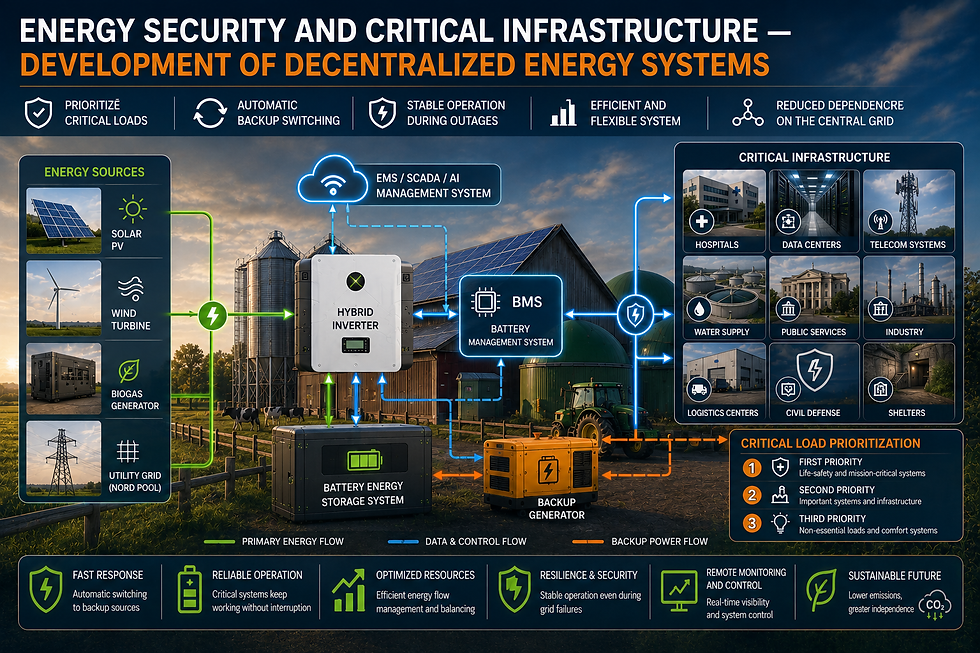
Almost all modern heating systems depend on electricity — pellet boilers, heat pumps, gas boilers, and district heating require power for control and circulation. Without electricity, only traditional fireplaces or wood stoves can operate independently.
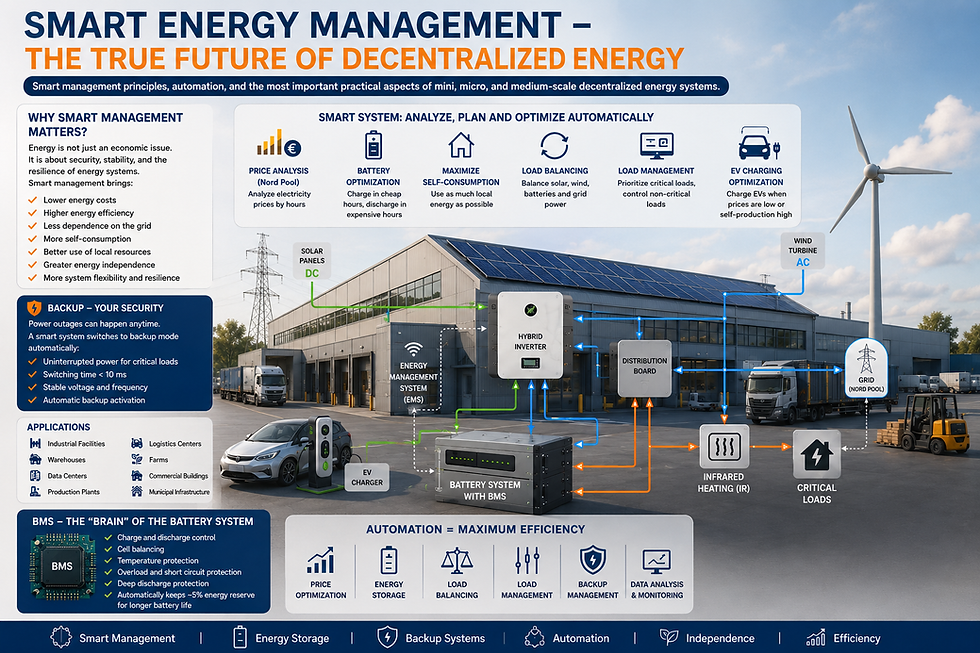
In households with photovoltaic (PV) systems, heating operation during power outages can be maintained using a backup generator. A hybrid inverter with generator input enables automatic switching to backup power.
A PV system with battery storage and generator connection provides uninterrupted power supply and stable heating operation in emergency situations.
This configuration is particularly effective with infrared heating, as infrared heaters convert electricity directly into heat without mechanical or hydraulic intermediaries. This ensures a simple, reliable, and predictable operation within PV + battery systems.
Conclusion
In Latvia’s climate, choosing a heating system is not only about initial investment or electricity prices. Heating security, operational stability, and the ability to maintain comfort during prolonged cold periods are equally important.
Centralized systems rely on a single heat source. While powerful, a failure can interrupt heating for the entire building.
Infrared heating, based on a decentralized principle, reduces single-point failure risk, enables precise comfort control, and maintains constant efficiency regardless of outdoor temperature. It requires no fuel, chimney, or regular maintenance and naturally integrates with solar panels and home battery systems.
Therefore, considering safety, ease of maintenance, energy efficiency, and long-term operating costs, infrared heaters represent a technologically sound and future-ready heating solution for Latvian winters.
Important Note
Infrared heating is not conventional convection heating.
It does not heat the air but directly warms surfaces and people, providing uniform comfort without air circulation or heat stratification.
It allows heating only the zones that are actually needed, instead of the entire air volume, reducing unnecessary energy consumption.
100% heat for you — not for the air.