Development of small and medium wind turbine technologies in the Nordic climate
- May 25
- 5 min read

Small and Medium Wind Turbine Technologies and Modern Energy Systems
In recent years, the small and medium wind turbine market has been changing rapidly.
In the past, most systems were relatively simple:
fixed pitch
basic controllers
minimal automation
no energy storage
Today, however, the market is increasingly moving toward:
🟧✓ smart energy management
🟧✓ hybrid systems
🟧✓ energy storage
🟧✓ automated control
🟧✓ higher efficiency in low wind conditions
🟧✓ improved safety in strong winds
This is especially important in Nordic and Baltic climates, where stable annual energy production in real weather conditions matters more than just nominal power output.
1. Fixed Pitch Technology
In fixed pitch systems, the blade angle remains fixed and does not change.
Simply put:
the blades always stay in the same position regardless of wind speed.
This means the turbine cannot fully adapt to:
🟧✓ low wind conditions
🟧✓ changing wind conditions
🟧✓ very strong winds
This approach is technically simpler and cheaper, but real-world efficiency is often lower.
It can be compared to a car with only one gear.
Advantages:
🟧✓ simpler construction
🟧✓ lower initial costs
🟧✓ easier maintenance
Disadvantages:
🟧✓ lower efficiency in changing winds
🟧✓ poorer performance in strong winds
🟧✓ lower annual energy production
This technology is still commonly found in lower-cost small wind turbines.
2. Pitch Control Technology
In pitch control systems, the blade angle automatically changes depending on wind speed.
Simply put:
the turbine continuously adjusts blade position for optimal performance.
This allows more efficient use of:
🟧✓ low winds
🟧✓ variable winds
🟧✓ strong wind gusts
That is why pitch control technology is becoming increasingly important in Nordic climates, where wind conditions vary significantly throughout the year.
It can be compared to a modern automatic transmission that constantly adapts to driving conditions.
As a result, the system can:
🟧✓ produce more electricity
🟧✓ operate more stably
🟧✓ reduce mechanical stress
🟧✓ improve safety in strong winds
In some conditions, pitch control systems can deliver significantly higher annual energy production compared to simpler fixed pitch systems.
3. Direct Drive Generators
Traditional wind turbines often use a gearbox to transfer rotational force from the blades to the generator.
Direct drive systems eliminate the gearbox.
This means:
the blades are connected much more directly to the generator.
As a result, the system has:
🟧✓ fewer moving parts
🟧✓ lower vibration levels
🟧✓ quieter operation
🟧✓ lower mechanical failure risk
That is why direct drive technology is becoming increasingly popular in premium systems.
However, such systems usually have:
🟧✓ higher costs
🟧✓ greater weight
4. Permanent Magnet Generator (PMG)
PMG technology uses permanent magnets that allow electricity generation at lower rotational speeds.
Simply put:
the generator can operate more efficiently even in lower wind conditions.
This is especially important in Nordic climates, where:
🟧✓ wind conditions are often variable
🟧✓ a large part of the year consists of low and medium wind speeds
PMG systems typically provide:
🟧✓ higher efficiency in low wind
🟧✓ more stable electricity generation
🟧✓ lower energy losses
That is why PMG technology is increasingly used in higher-quality small and medium wind turbines.
5. Variable Speed Technology
Variable speed systems allow the wind turbine to automatically change rotational speed depending on wind strength.
Simply put:
the turbine does not rotate at one constant speed.
In low wind:
🟧✓ rotation is slower
In stronger wind:
🟧✓ rotation speed increases
This allows the system to adapt much more efficiently to real weather conditions.
As a result, it becomes possible to:
🟧✓ increase annual energy production
🟧✓ reduce vibrations
🟧✓ reduce mechanical stress
🟧✓ improve overall system stability
Today, variable speed technology is increasingly becoming the standard in high-quality systems.
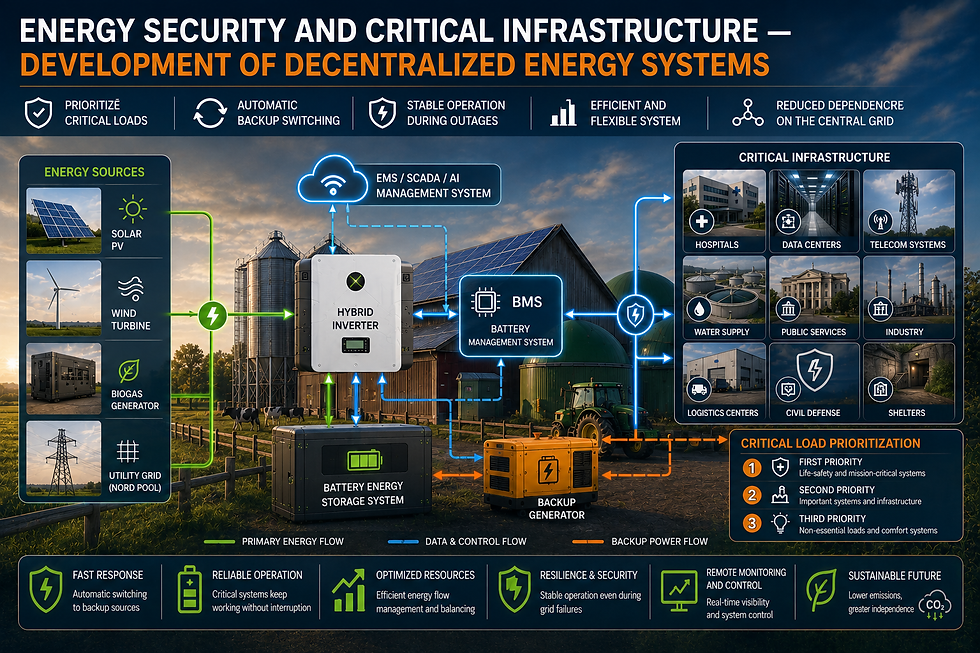
6. Smart Hybrid Systems
Modern small and medium wind turbines are increasingly integrated into hybrid energy systems.
These systems combine:
🟧✓ wind turbines
🟧✓ solar panels
🟧✓ battery storage
🟧✓ hybrid inverters
🟧✓ smart energy management
Advantages:
🟧✓ more stable energy availability
🟧✓ more efficient use of self-generated electricity
🟧✓ Nord Pool optimization
🟧✓ backup power capability
🟧✓ greater energy independence
This is currently one of the fastest-growing directions in the energy market.
7. Smart Safety Technologies
Modern wind turbines increasingly rely on automated safety systems.
These include:
🟧✓ automatic braking
🟧✓ storm protection modes
🟧✓ vibration monitoring
🟧✓ electronic protection systems
🟧✓ remote monitoring
🟧✓ automatic diagnostics
These safety systems significantly affect turbine lifespan and operational reliability.
8. Why the Entire Energy System Matters — Not Just Turbine Power
Many people initially focus only on:
wind turbine power output (kW).
However, in real-world conditions, the efficiency of small and medium wind turbines is often determined not only by the turbine itself, but by the entire system.
Electricity production is heavily influenced by:
🟧✓ mast height
🟧✓ turbulence
🟧✓ installation location
🟧✓ inverter quality
🟧✓ energy management
🟧✓ battery storage systems
🟧✓ Nord Pool optimization
For example, two identical wind turbines installed in different locations can produce completely different annual energy outputs.
That is why modern energy systems increasingly focus on:
❌ not just a single turbine,
but:
✅ intelligently integrated energy systems.
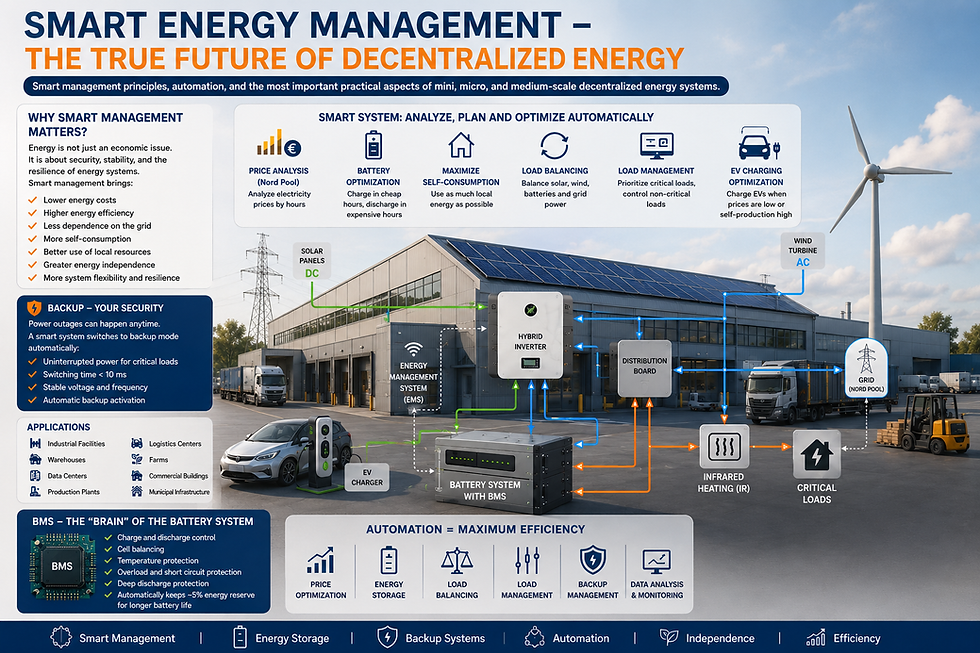
9. Nord Pool Optimization and Smart Energy Management
In modern energy systems, it is becoming increasingly important not only:
how electricity is produced,
but also:
when electricity is used.
In the Nordic and Baltic regions, Nord Pool electricity prices change every 15 minutes.
This means electricity prices can fluctuate significantly throughout the day depending on:
🟧✓ wind intensity
🟧✓ solar generation
🟧✓ total demand
🟧✓ weather conditions
🟧✓ seasonal changes
🟧✓ electricity import and export flows
It is important to understand that Nord Pool optimization is usually not determined by the wind turbine technology itself.
It is mainly controlled by:
🟧✓ hybrid inverter
🟧✓ energy management system (EMS)
🟧✓ battery storage system
🟧✓ automation capabilities
🟧✓ system software
Modern systems can:
🟧✓ automatically charge batteries during lower-price Nord Pool hours
🟧✓ use stored energy during expensive hours
🟧✓ combine wind and solar generation in one system
🟧✓ reduce grid consumption during peak hours
🟧✓ use intelligent automatic operating modes
This is where one of the biggest advantages of modern energy systems appears:
❌ it is no longer enough simply to generate electricity,
but also:
✅ to use electricity intelligently.
Conclusion — Where Is the Small and Medium Wind Turbine Market Heading?
The modern market is increasingly moving away from:
❌ “simple standalone wind turbines”
and toward:
✅ smart integrated energy systems.
Today, technology integration determines:
🟧✓ electricity production
🟧✓ system stability
🟧✓ safety
🟧✓ return on investment
🟧✓ energy independence
In Nordic climates, the following are becoming increasingly important:
energy storage
smart energy management
wind and solar integration
efficient heating
decentralized energy production
However, when looking specifically at wind turbine technology development, one of the most important directions today is:
✅ pitch control technology.
Pitch control systems are increasingly becoming the standard in high-quality small and medium wind turbines because they allow:
🟧✓ more efficient use of low and variable winds
🟧✓ higher annual electricity production
🟧✓ reduced mechanical stress
🟧✓ improved safety in strong winds
🟧✓ more stable operation in Nordic climates
Modern energy systems are no longer only about generating electricity.
Increasingly important becomes:
when electricity is generated
when it is stored
and when it is used
That is why the future increasingly belongs to smart hybrid energy systems, where modern pitch control wind turbines operate together with solar panels, battery storage, hybrid inverters, and intelligent energy management as one coordinated system.